

Key Takeaways
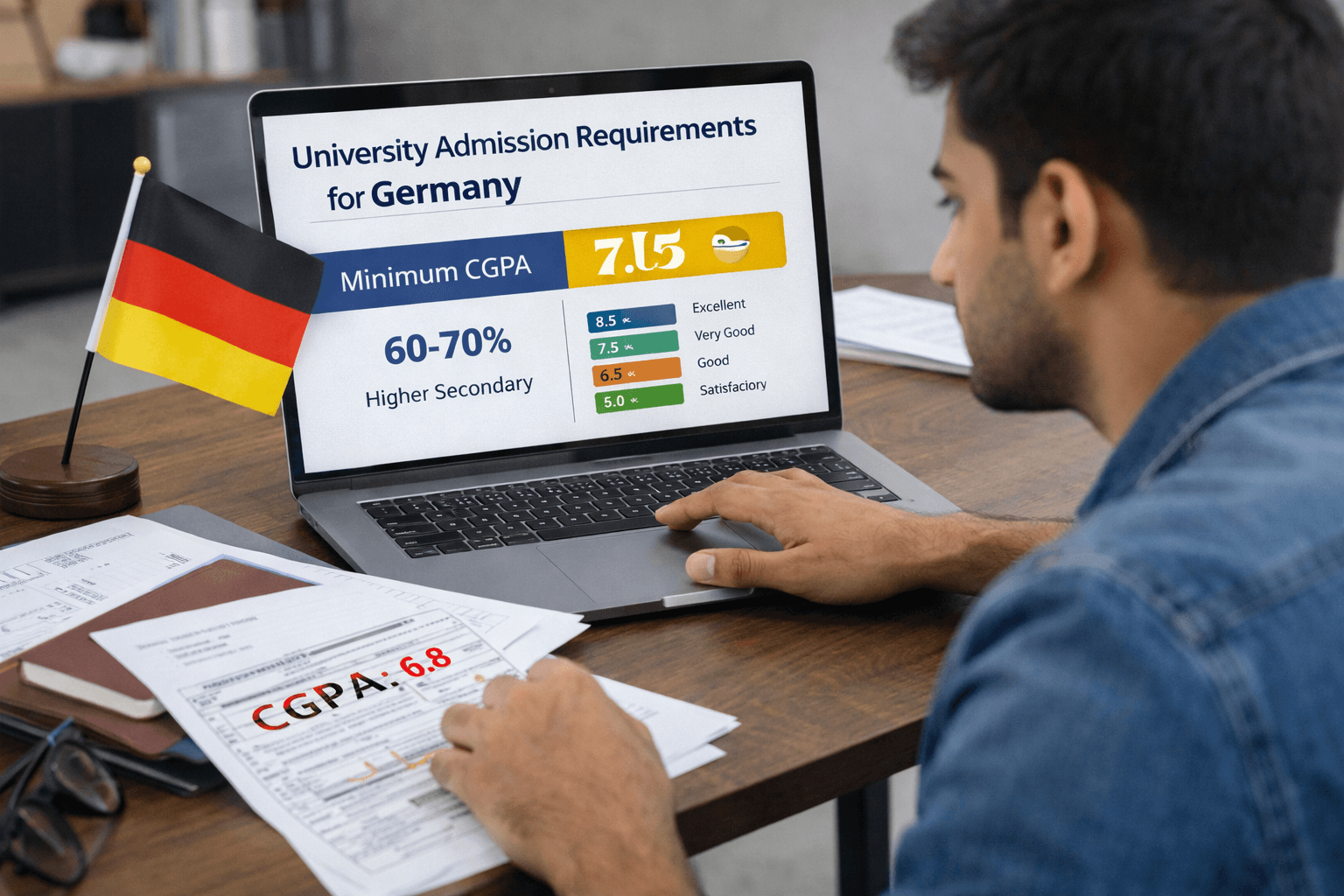
No universal minimum CGPA for German universities; requirements vary by program and institution (typically 7.0/10 for master's, 60-70% for bachelor's).
Top universities expect 8.0+ CGPA; Universities of Applied Sciences may accept 6.0-6.5 with strong profiles.
Low CGPA (6.0-7.0) can be offset by SOP, work experience, language scores, LORs, and certifications.
Additional requirements: APS certificate (for Indians), relevant degree, IELTS/TOEFL/TestDaF, transcripts, CV.
Apply early to multiple universities and focus on overall profile for better chances.
In this Article
Germany is one of the most popular destinations for international students because of its world-class universities, affordable education, and strong career opportunities after graduation. Many students planning to study in Germany often ask an important question: What is the minimum CGPA required for admission to German universities?
The answer is that there is no single universal CGPA requirement, because each university and program sets its own admission criteria. However, there are general academic expectations that international students should meet to improve their chances of admission.
This guide explains the typical CGPA requirements for studying in Germany and how students with lower grades can still get admission.
Minimum CGPA for Master’s in Germany
For most master’s programs in Germany, universities expect students to have a minimum CGPA of around 7.0 out of 10 (or about 70%) in their bachelor’s degree.
However, requirements vary depending on the university and the competitiveness of the program.
Typical CGPA Expectations
- Top universities (TU9 / highly competitive programs): 8.0 – 8.5 CGPA
- Public universities: around 7.0 CGPA
- Universities of Applied Sciences (Fachhochschule): 6.0 – 6.5 CGPA may be accepted
Competitive universities such as leading technical institutions may require stronger academic records because of limited seats and high demand.
Minimum CGPA for Bachelor’s in Germany
For undergraduate programs in Germany, the requirements depend mainly on the student’s 12th-grade marks and eligibility for German university entrance qualification.
Typical expectations include:
- Around 60–70% in high school (12th grade)
- Completion of 13 years of education or a foundation year (Studienkolleg) for some students
Some universities also require students to pass an entrance exam called Feststellungsprüfung if they study through Studienkolleg.
German Grade Conversion System
German universities often convert international grades into the German grading system, where:
- 1.0 = Excellent
- 2.0 = Very Good
- 2.5 = Good
- 3.0 = Satisfactory
- 4.0 = Minimum passing grade
Many universities require a German grade of 2.5 or better for admission to master’s programs.
Can You Study in Germany with Low CGPA?
Yes, students with lower CGPA can still get admission in Germany because not all universities have strict grade requirements.
Students with CGPA between 6.0 and 7.0 may still get admission if they strengthen other parts of their profile.
Ways to Compensate for Low CGPA
- Strong Statement of Purpose (SOP)
- Relevant work experience or internships
- Good IELTS or TOEFL scores
- Strong Letters of Recommendation
- Additional certifications or projects
Some universities of applied sciences also focus more on practical skills and experience than just grades.
Other Important Requirements to Study in Germany
Besides CGPA, universities also evaluate several other factors before granting admission.
1. Bachelor’s Degree in a Relevant Field
Your undergraduate degree should match the master’s program you are applying for.
2. Language Proficiency
- English-taught programs: IELTS 6.0 – 6.5 or TOEFL
- German-taught programs: TestDaF or DSH
3. APS Certificate
Indian students must obtain an APS certificate before applying to German universities.
4. Documents Required
Students usually need:
- Academic transcripts
- Passport copy
- CV / Resume
- Statement of Purpose
- Letters of Recommendation
Tips to Increase Admission Chances in Germany
Even if your CGPA is average, you can still improve your chances of getting admission by following these strategies:
- Apply to multiple universities
- Choose programs related to your academic background
- Write a strong motivation letter
- Prepare all documents carefully
- Apply early before the deadline
Final Thoughts
Germany offers excellent education opportunities for international students, and the minimum CGPA requirement usually ranges from 6.0 to 8.0 depending on the university and program. While top universities expect higher academic performance, many universities still accept students with moderate CGPA if they have a strong overall profile.
With the right preparation, clear academic goals, and proper documentation, students can successfully secure admission and pursue higher education in Germany.
Explore More Opportunities
Ready to Study in Germany? Get Expert Guidance!
Our counselors can help assess your CGPA, find matching programs, and prepare your application. Free consultation.
Frequently Asked Questions
What is the minimum CGPA for master's in Germany?
Typically 7.0/10 (70%) for most programs; top universities like TU9 require 8.0+. Universities of Applied Sciences accept 6.0-6.5 with strong profiles.
Can I study in Germany with 6.5 CGPA?
Yes, especially at Universities of Applied Sciences. Offset with SOP, internships, IELTS 6.5+, LORs, and APS certificate.
What is APS certificate for Indian students?
Mandatory verification of academic documents by APS India before university applications. Costs ~₹18,000; processing 4-6 weeks.
How to convert Indian CGPA to German grades?
Use Modified Bavarian Formula: German Grade = 1 + 3*(Nmax - N)/(Nmax - Nmin), where N is your % score. Aim for 2.5 or better.
Is IELTS required for Germany study visa?
For English programs: IELTS 6.0-6.5 or TOEFL. German programs: TestDaF/DSH. Blocked account (€11,208/year) also needed for visa.
Success Stories

Priya S., India (2025)
"With a 6.8 CGPA, I got into a Master's at FH Aachen thanks to their advice on SOP and APS! – "
Reader Reviews
Rahul M., 2026
“This guide helped me understand grade conversion. Admitted to TU Munich with 7.5 CGPA”
Neha K., 2025
“Low CGPA wasn't a barrier after adding internships. Now studying in Berlin!”
Aniket K
“Comprehensive guide! Cleared all doubts on CGPA for Germany.”

Written By
Sayali Yadav
Sayali Yadav has been living in Germany for the past four years. She holds a Master’s degree in Quantitative Molecular Biology from Humboldt University of Berlin, one of Germany’s top five universities and home to over 50 Nobel Laureates. She has worked at the Nobel Laureate’s Charpentier Lab at the Max Planck Institute and at the Max Delbrück Center in Berlin. She is also the co-founder of Edulx, an initiative that guides Indian students in securing admission to German public universities and supports them throughout their academic journey.