

In this Article
Germany has become one of the top study destinations for Indian students because of low tuition fees, strong job opportunities, and PR pathways. However, since the introduction of the APS certificate requirement, the application process has changed significantly.
Earlier, students could directly apply to universities and visas. Today, APS verification is one of the first and most important steps before moving forward with admissions and visa applications.
Understanding how APS changed the system helps students avoid delays and plan better.
What Is the APS Certificate?
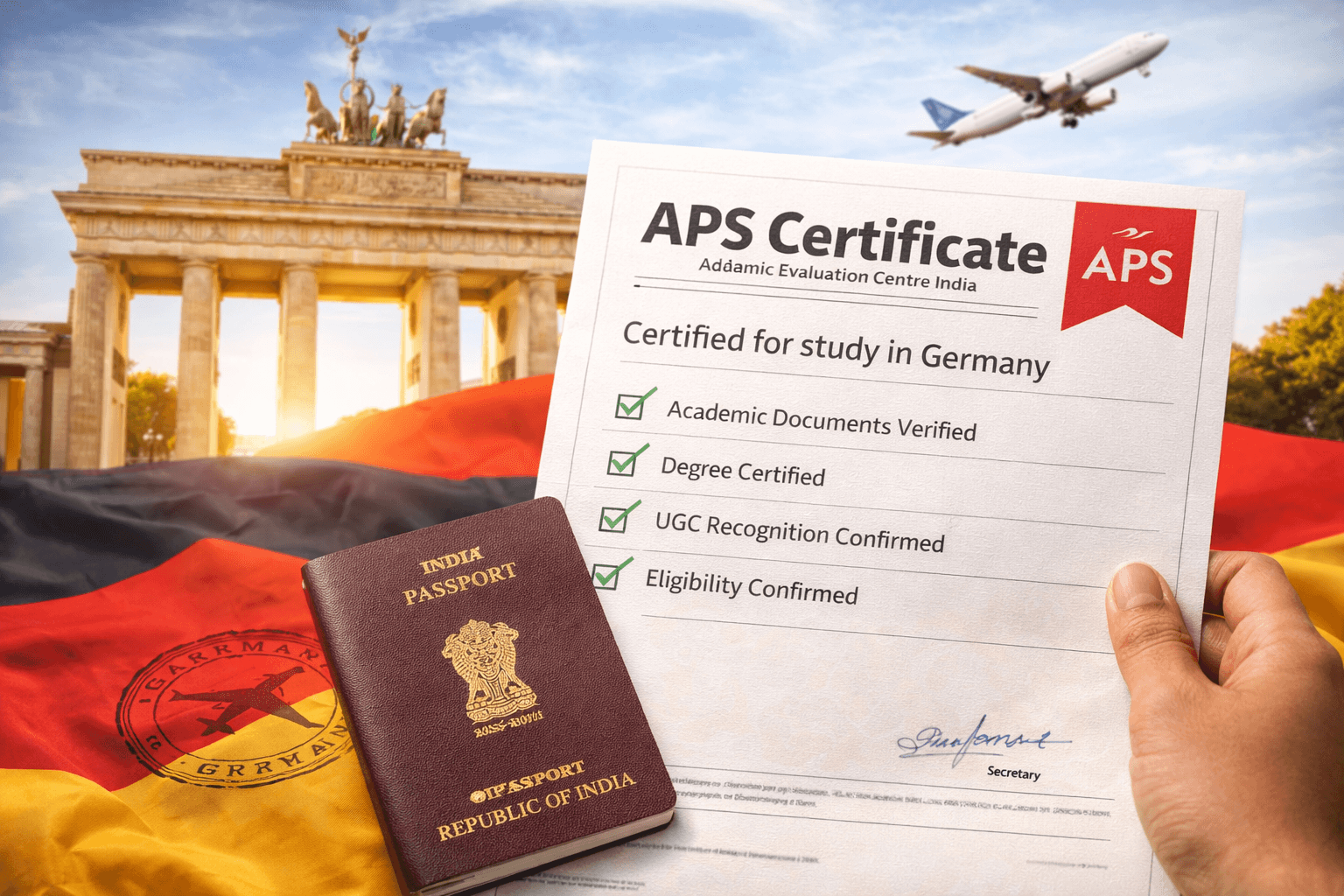
APS (Academic Evaluation Centre) verifies whether your Indian academic documents are genuine and whether you are eligible to study in Germany.
It confirms:
- Marksheets authenticity
- Degree validity
- University recognition status
- Academic eligibility for German education
Without APS, most Indian students cannot proceed with the Germany student visa application.
Before APS: How Germany Applications Worked Earlier
Before APS became mandatory:
Students could:
- Apply directly to universities
- Submit documents during admission stage
- Apply for visa without prior academic verification
Because verification happened later, fraud risks increased and visa delays were common.
To fix this issue, Germany introduced APS verification specifically for countries with high application volumes like India.
After APS: How the Germany Application Process Changed
Today the process looks like this:
Step 1 → Apply for APS
Step 2 → Receive APS verification
Step 3 → Apply to universities
Step 4 → Receive admission
Step 5 → Apply for visa
This change means APS is now the starting point of your Germany journey.
Major Ways APS Changed Applications for Indian Students
1. APS Became Mandatory for Student Visa Applications
Since 2022, Indian students must submit an APS certificate before applying for a Germany student visa.
Without APS:
❌ Visa application cannot proceed
❌ Admission enrollment may be delayed
APS is now a core document like IELTS or transcripts.
2. Applications Became More Structured and Transparent
Earlier:
Students applied first → verification later
Now:
Verification first → admission later
This improves:
✅ application credibility
✅ faster university evaluation
✅ smoother visa processing
3. Processing Time Used to Be a Big Challenge (But Improved in 2026)
Initially, APS processing could take 4–6 months, delaying admissions significantly.
In 2026, APS India shifted to digital verification and processing now takes around 3–4 weeks, which is a major improvement for students applying for Winter intake.
This change allows students to apply earlier and plan better.
4. Courier-Only Document Submission Rule Introduced
APS India now accepts documents only via courier/post submission, and in-person queries are not allowed.
Students must:
- prepare documents carefully
- submit complete sets
- avoid missing paperwork
Incomplete submissions increase delays.
5. APS Now Verifies Entire Academic Background
APS verification reports now reflect the full academic history of applicants, making evaluation more comprehensive and transparent.
This helps universities trust applications faster.
6. Recognition Rules for Private Universities Became Strict
From 2024 onwards:
Students from Indian private universities without proper UGC recognition may not receive APS approval.
Students must check their university recognition status before applying.
This change directly impacts eligibility.
7. New 70% Requirement Update for Bachelor’s Applicants (2026)
From Winter Semester 2026:
Students applying for Bachelor’s programs or Studienkolleg pathways typically require minimum 70% in Class 12 under updated APS eligibility alignment with Anabin standards.
This affects undergraduate applicants significantly.
Does APS Affect Master’s Students Also?
Yes — especially in visa stage.
Some universities may allow applications before APS submission temporarily, but APS is still mandatory before enrollment or visa approval in most cases.
So Master’s students should apply for APS early.
Benefits of APS for Genuine Students
Although APS added an extra step, it also improved the system.
Advantages:
✅ reduces document fraud
✅ improves visa approval confidence
✅ speeds university verification
✅ strengthens application credibility
✅ improves processing transparency
Today APS actually protects serious applicants.
Common Mistakes Indian Students Make With APS
Avoid these:
❌ Applying late
❌ Sending incomplete documents
❌ Not checking university recognition
❌ Uploading incorrect marksheets
❌ Ignoring courier tracking
Applying early improves admission chances.
When Should Students Apply for APS?
Best timeline:
For Winter Intake → Apply between October – January
For Summer Intake → Apply between May – August
Early APS approval = early university applications.
Final Thoughts
APS has completely reshaped the Germany admission process for Indian students.
Earlier:
University first → visa later
Now:
APS first → university → visa
Students who understand this change early can:
✔ apply faster
✔ avoid delays
✔ improve admission chances
✔ secure visa appointments earlier
Planning APS at the right time is now the key to successful Germany admission in 2026.
Explore More Opportunities

Written By
Aniket Kulkarni
Specialized in modern computing solutions and technical innovation, Aniket combines academic rigor from the Technical University of Applied Sciences Würzburg-Schweinfurt (THWS) with a global perspective on the European tech landscape.