

In this Article
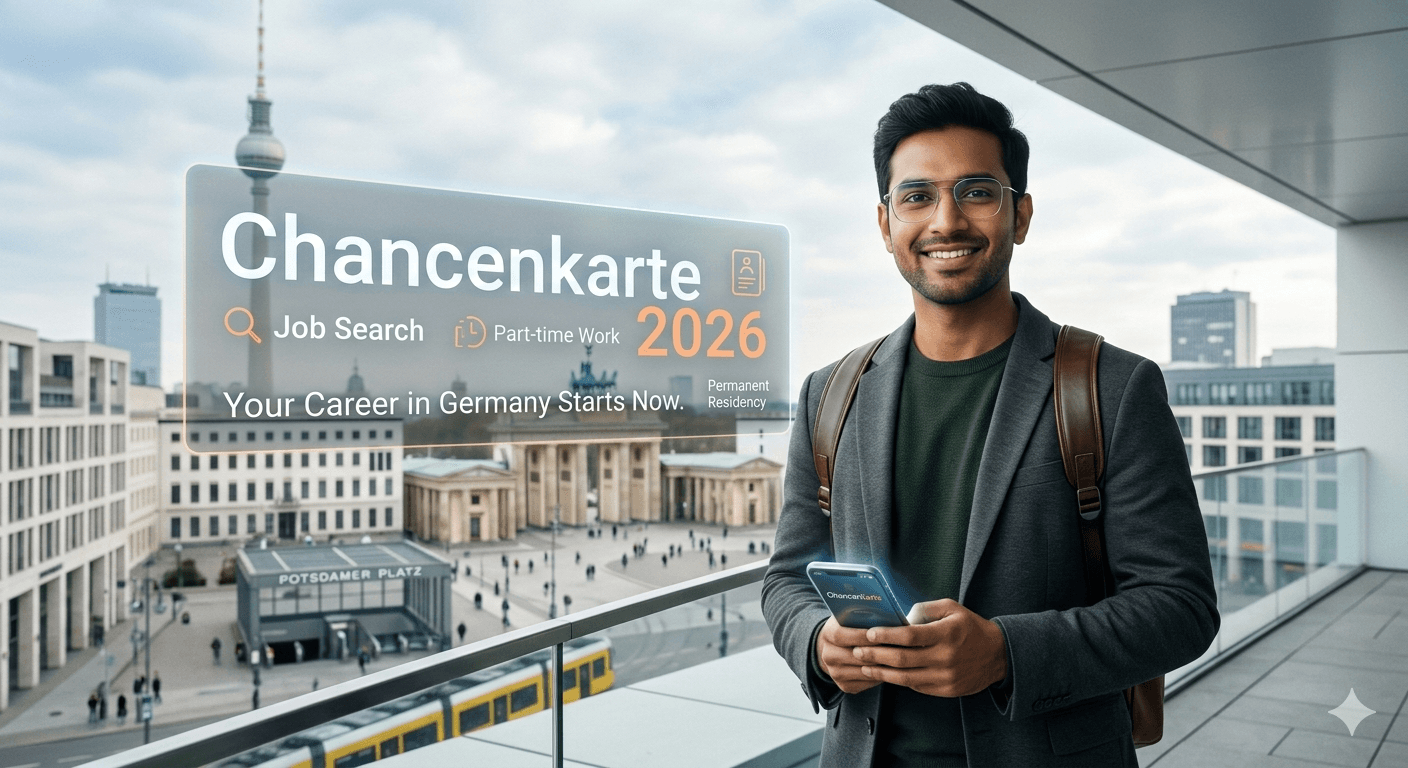
Germany has officially opened its doors wider for international talent. The German Opportunity Card, also known as the Chancenkarte, is a game-changing visa program launched to attract skilled individuals. Unlike traditional work visas, this allows you to enter Germany without a job offer, giving you up to one year to find the right role.
Whether you are in Engineering, IT, or Healthcare, this guide breaks down exactly how you can use your professional skills to relocate to Europe’s largest economy.
Why the Opportunity Card is a Game Changer
- Search on the Ground: Spend up to one year living in Germany while interviewing for full-time positions.
- Work While You Search: You are permitted to work part-time (up to 20 hours per week) and engage in unlimited two-week "trial jobs" to see if a company is the right fit.
- Easy Transition: Once you find a job, you can transition directly to a permanent work visa or EU Blue Card without leaving the country.
Two Paths to Qualification
There are two distinct ways to qualify for the Chancenkarte. You only need to meet the criteria for one of these routes.
Path 1: The Skilled Worker Route This path is for those who already have a degree or vocational training recognized in Germany.
- Requirement: A foreign university degree or vocational qualification that is fully recognized. (Check the Anabin Database or get a ZAB Statement of Comparability).
- Benefit: If you follow this route, you do not need to prove language skills or accumulate points.
Path 2: The Points-Based System If your degree isn't fully recognized yet, you must earn a minimum of 6 points based on the criteria below.
The Opportunity Card Points System Explained
To be eligible for the points-based route, you must first have a recognized qualification (minimum 2 years of training) and basic language skills (German A1 or English B2). Once you meet that baseline, you accumulate points as follows:
4 Points
- Confirmed partial recognition of your foreign qualification by German authorities.
3 Points
- Five years of professional experience in your field within the last seven years.
- OR Proficient German language skills at level B2 or above.
2 Points
- Being under the age of 35.
- Two years of professional experience within the last five years.
- OR German language skills at level B1.
1 Point
- Being between the ages of 36 and 40.
- Previous legal stay in Germany (at least 6 months in the last 5 years).
- English proficiency at level C1.
- Having a "Bottleneck Profession" (skills in high demand).
- Spouse also meeting the requirements for an Opportunity Card.
Real-Life Example: Ravi Kumar (Electrical Engineer)
Ravi is 37 years old from India. He holds an M.Sc. in Electrical Engineering. Here is how he scores 12 points:
- 4 points: Partial recognition of his degree.
- 3 points: 6 years of work experience.
- 1 point: Age (37).
- 1 point: English C1.
- 1 point: Previous 1-year stay in Germany.
- 1 point: Bottleneck profession.
- 1 point: Spouse eligibility. Total: 12 Points (Qualified!)
Financial Requirements and Proof of Funds
To secure the visa, you must prove you can support yourself. The most common way to do this is through a Blocked Account.
- Requirement: Approximately €1,091 per month (roughly €13,092 for the full year).
- Alternative: A signed part-time job contract in Germany or a Letter of Guarantee (Verpflichtungserklärung).
- Health Insurance: You must have valid health insurance coverage for the duration of your stay.
Required Documents Checklist
Before applying at the German Embassy or via the Consular Service Portal, ensure you have:
- Valid Passport: Issued in the last 10 years with 2 empty pages.
- Proof of Residence: Aadhaar card or registration certificate.
- Academic Proofs: Degree certificates and recognition notices.
- Financial Proof: Blocked account confirmation.
- Language Certificates: Official German (Goethe/TestDaF) or English (IELTS/TOEFL) results.
Opportunity Card vs. Job Seeker Visa
Many students ask: How is this different from the old Job Seeker Visa?
- Duration: The Opportunity Card is for 1 year; the Job Seeker Visa was usually 6 months.
- Work Rights: You can work part-time on the Opportunity Card; you could not work at all on the Job Seeker Visa.
- Flexibility: The points system allows people with "potential" to enter, even if their degree isn't 100% equivalent yet.
Upcoming Webinar: Everything You Need to Know
Date: March 27th, 2026 Join us for a live tutorial on how to verify your degree and a Q&A session to answer your specific visa questions. Don't miss out on your chance to move to Germany this year!
Explore More Opportunities

Written By
Sayali Yadav
Sayali Yadav has been living in Germany for the past four years. She holds a Master’s degree in Quantitative Molecular Biology from Humboldt University of Berlin, one of Germany’s top five universities and home to over 50 Nobel Laureates. She has worked at the Nobel Laureate’s Charpentier Lab at the Max Planck Institute and at the Max Delbrück Center in Berlin. She is also the co-founder of Edulx, an initiative that guides Indian students in securing admission to German public universities and supports them throughout their academic journey.